
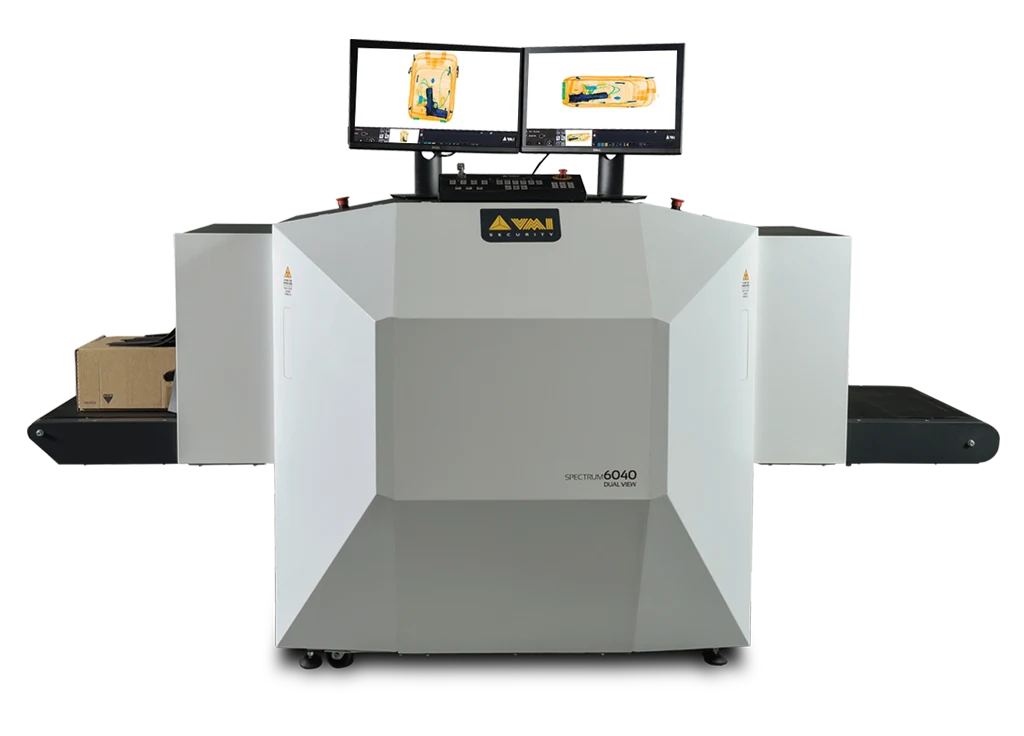
AIRPORT CHECKPOINT SCREENING
High-quality dual-view inspection for demanding checkpoints.
The VMI 6040DV combines two simultaneous X-ray perspectives, advanced image processing and dependable operational performance to help security teams inspect cabin baggage efficiently and confidently.
Overview
The VMI 6040DV was developed for airports and other high-security environments where image quality, operational reliability and regulatory compliance are critical. Its dual-view imaging technology provides two simultaneous perspectives of every inspected item, helping operators reduce object overlap and improve threat detection without slowing checkpoint operations.
Key Highlights
TSA Qualified
Designed for passenger checkpoint applications requiring qualified screening equipment.
Dual-View Technology
Two simultaneous X-ray images improve object visibility and reduce image ambiguity.
High Image Quality
Advanced image processing clearly differentiates organic, inorganic and mixed materials.
Continuous Operation
Engineered for demanding security environments operating throughout the day.
Operator-Friendly
Intuitive controls and comprehensive image-enhancement functions support efficient screening.
Network Ready
Supports network connectivity, remote management and ONVIF-compatible integration.
Typical Applications
- Airport passenger checkpoints
- Government facilities
- Embassies
- VIP terminals
- Critical infrastructure
- Corporate headquarters
- High-security buildings
Technical Specifications
Specifications below are taken from the official VMI Spectrum 6040 DV brochure supplied for this project.
| Tunnel Size | 621 (W) × 420 (H) mm |
|---|---|
| Imaging Configuration | Dual view |
| Generator Voltage | 160 kV operating at 150 kV; optional 180 kV operating at 170 kV |
| Conveyor Speed | 0.22 m/s |
| Conveyor Load | 80 kg standard; optional 160 kg or 200 kg |
| Wire Resolution | 40 AWG |
| Steel Penetration | 42 mm at 150 kV; 44 mm at 170 kV |
| Monitor | High-resolution monitor; configurable size |
| Image Storage | More than 200,000 images |
| Operating Temperature | 0°C to 40°C; 5% to 95% RH, non-condensing |
| Power Requirements | 110–127 VAC / 208–240 VAC (-15% to +10%); 50/60 Hz ±3 Hz; 1060 VA |
| Dimensions | 2528 (L) × 1164 (W) × 1247 (H) mm |
| Weight | 623 kg |
Image Enhancement Functions
- Organic, inorganic and mixed-material colour differentiation
- High penetration
- Edge enhancement
- Sharpness adjustment
- Colour and black-and-white modes
- Colour inversion
- Zoom above 128×
- Real-time image manipulation
- Automatic image saving
- Image archive and export
Operational Benefits
- Faster passenger throughput
- Improved operator confidence
- Reduced image ambiguity
- High-quality image generation
- Reliable continuous operation
- Simplified operator workflow
Optional Functions and Accessories
- Modular roller tables
- UPS
- Remote workstation
- Remote management software
- Training software
- ASTM standard test kit
- Wi-Fi capability
- Garrett walk-through metal-detector integration
Downloads
VMI Spectrum 6040 DV Brochure
Official product brochure with technical specifications, standard functions and available accessories.
Frequently Asked Questions
Why choose a dual-view X-ray scanner?
Dual-view imaging provides two simultaneous perspectives, reducing object overlap and supporting faster, more confident image interpretation.
Is the VMI 6040DV suitable for airports?
Yes. It was specifically developed for demanding security applications such as airport passenger checkpoints.
Can the scanner integrate with existing airport infrastructure?
Integration options depend on the operational environment and project requirements. The system supports network connectivity, remote management and ONVIF compatibility.
Is operator training available?
Yes. Screenix can include operator and technical training within the project implementation scope where required.
Why Screenix
Purchasing an X-ray scanner is only one part of a successful security screening project. Screenix supports the complete lifecycle, including needs assessment, equipment selection, implementation planning, commissioning, operator training and long-term technical support.